
Nobody answers your phone after hours. That is not the problem.
Published .
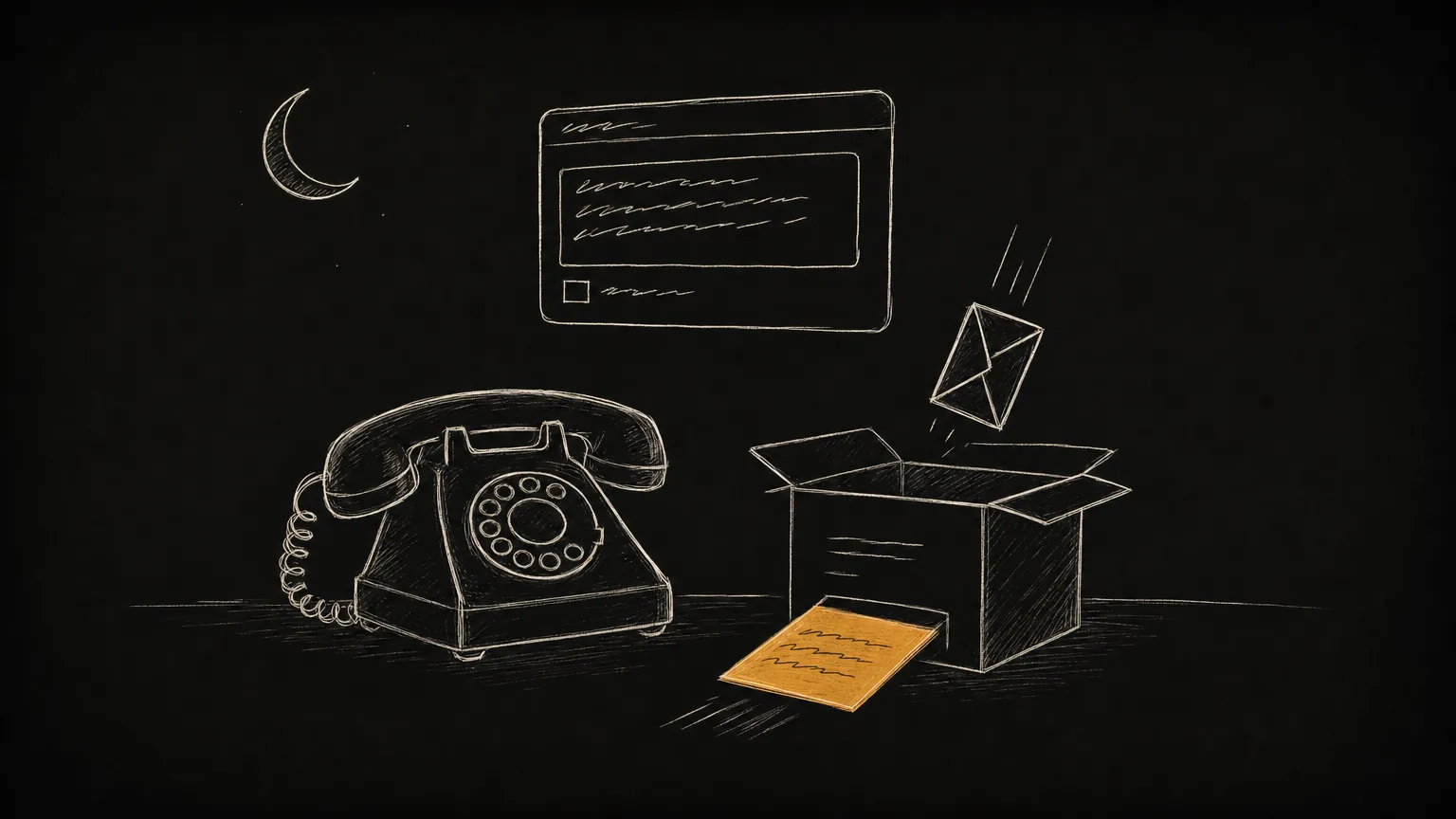
An inquiry that reaches your firm after hours should get an answer that night, and at almost every firm we looked at this summer it gets nothing until Monday. Not a slow something. Nothing. The phone rings into a box. The form swallows the whole story and says “Thank you.” The vendors on page one of Google want to sell you a person to pick up that phone, which repairs the one part of this that was never broken. Three rules cover what should happen instead, and a five-minute check tonight, from your own phone, shows what happens at yours.
What your contact page says at night
It says your hours. We read a few hundred law-firm contact pages this summer, one at a time, the way somebody with a real problem reads them: on a phone after work, with the question already typed out in their head. Almost all of them print the office hours beside the form, so the first thing the page tells a person at night is that nobody is home.
Under the hours there is a phone number. Ring it and you get a greeting somebody recorded a few years ago, in a hurry, with the door open. Then a beep, and the small doubt about whether the box is full, because it has been full before.
Under the number there is the form. One big box: describe your situation. The person does, because they have been rehearsing it since dinner. Some pages put a smaller box under the big one, asking the person to tick it to confirm they have not included anything confidential. The form asks for the whole story, then asks the person to promise they did not tell it. Submit, and the page says “Thank you. We will be in touch.”
About one page in ten says when, or who will call. The best of them print something like “we answer every inquiry personally, usually within one business day”. That is the most a contact page told us, and it is still a promise that nothing happens tonight.
The person closes the tab. The next firm is one search away, and its form does the same thing. Somewhere down the list a page answers, and that firm gets the consultation.
What you have on Monday
A voicemail with a first name, most of a phone number and a television in the background. A form submission that says “custody” and an email address and nothing else. One of them could not wait, and did not, and is somebody else’s client by the time you read it. That is an ordinary Monday for a firm whose contact page prints its hours. An inquiry that arrives at eight on a Friday evening waits about sixty hours.
An answering service, in your firm’s name, twenty-four hours a day, will take a message. Great. Now you have a message. It says roughly what the voicemail would have said, and you read it on Monday, same as the voicemail. The caller heard a human voice, which is something, and then heard “someone will call you back”, which the page already said. And the person who filled in the form never called at all, so the service never met them. Somebody picks up the phone, and the inquiry still waits for Monday.
What should happen instead
Hold any after-hours setup, yours included, against three rules. Whatever meets them is doing the job. Whatever does not is a greeting.
1. In the moment, the person gets something back. At minimum, what happens now and when. At best, an answer to the question they asked: what their options usually are and what happens next in a matter like theirs. That is information you would give on the phone before anyone signs anything, and it is not legal advice. Compare “closed” with “here is what people in your position usually need to know, and here is when a person will call”. Those two pages get different results from the same visitor at the same hour.
2. By morning, you have something you can act on. A summary you can read in a minute and decide on in the next: what kind of matter, what happened in the person’s own words, how to reach them, whether it can wait, and what they were already told.
3. If it cannot wait, a human tonight. Some inquiries are an arrest, a hearing in the morning, a child who was not brought back. Those reach a person the same night, and how is your call: an on-call number on the page, or a service that transfers to one. Software does not replace that rule.
What meets the standard
| Hours beside a form | Answering service | Intake assistant on your site | |
|---|---|---|---|
| In the moment | Nothing until Monday | A human voice and “someone will call you back” | An answer to the question and what happens next |
| By morning | A voicemail and a paragraph | A message: name, number, a line | A summary: matter, story, contact, urgency, what they were told |
| Cannot wait | Nothing | A transfer to your on-call number, if you set it up | Routes to your on-call human. Does not replace them |
| Covers the form | No | No | Yes |
The answering service is the right answer for the firm whose after-hours calls are emergencies. That is most often criminal defense, where rule three is most of the job. If that is you, buy the human. Any other firm is buying rule three to get an expensive version of rule two, and nothing at all for the person who typed instead of calling.
We built the intake assistant for rules one and two. It sits on your site, in your firm’s name, and when someone asks a question at night it answers it: in their language, in about a minute, inside rules the attorney wrote, with the consultation offered on your calendar. By morning you have the summary. At one practice we built this for, which we do not name, the client reported roughly 100 visitor questions in the first 2.5 weeks after launch, and about 33 of them became booked consultations. The figures are the client’s own and the window is short; the case study carries them with those caveats.
The assistant does not decide who qualifies or predict an outcome, and it does not pick up the phone at two in the morning. The compliance page covers how it stays on the right side of that line. There is a live one set up for a family-law practice; ask it something at eleven tonight, before you talk to anyone.
Find out what yours gets, tonight
Tonight, after you close, send your own firm an inquiry from your own phone. Call the number and listen to the whole greeting. Fill in the form and read what comes back. Then write down three things: what the person got in the moment, when anybody at the firm would have seen it, and what you would have known about them on Monday. Hold that against the three rules. That is your after-hours intake, whatever the brochure said. It takes five minutes and it is a little uncomfortable, which is the point.
If you want us to read it, put those three things in the message under “Get your intake reviewed”, with your practice area. You get back a straight answer on what it would take to meet all three rules at your firm.
Related services
Answer questions from your own documents
AI agents and LLM systems
A system that reads the documents, answers the questions, and routes what needs a person, with every answer traceable to the source it came from.
Put the repeating work on a schedule
Workflow automation
The process runs on a schedule, and a person reviews the exceptions instead of assembling the whole thing by hand every week.
See what your inquiries get after hours
Tell us what happens to a form submission or a call at your firm once the office closes. We review how your firm answers, books and follows up, then show you where the assistant fits.
- Your contact page
- Your after-hours path
- One clear next step
- Your attorneys stay in control